Infinity Pool
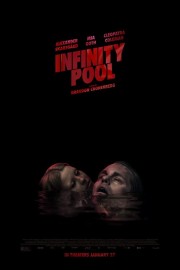
A lot of films came to mind while I was watching “Infinity Pool.” Chief among them was last year’s “Speak No Evil,” which grappled with its own concept of what it would be like to meet another couple on vacation, only to realize you were probably more accepting of them as you should have been. Whereas that film explored the nature of politeness and communication, Brandon Cronenberg offers an intriguing idea in terms of getting away with crime, and turns it into an unnerving look at violence as liberation. As much as I admired his previous film, “Possessor,” I think this one resonates stronger.
We begin with dialogue spoken in darkness before a woman opens the curtains- once you see the way the film unfolds, that is the perfect way to start a story this unsettling, because what is said away from prying ears matters more than what’s out front for people to see. James Foster (Alexander Skarsgård) and his wife, Em (Cleopatra Coleman), are on vacation in a resort compound in a fictional country, Li Tolqa. A festival is going on when they meet Gabi (Mia Goth), who was a fan of author James’s only novel. She’s immediately smitten with meeting James, much to Em’s discomfort. But James and Em later meet Gabi and her husband, Alban (Jalil Lespert), for dinner, and decide to go on a day trip with them. By the end of the day, an islander is dead, and the foursome just decide to act like it didn’t happen. When the truth comes out, however, the group is offered an unusual way to get away with murder, while still serving justice.
Whereas Brandon’s father David operates largely with natural visual landscapes for his surreal horror narratives, Brandon is much more willing to challenge the senses, whether it’s with a score by Tim Hecker that is both sinuous and nerve-racking, or the cinematography by Karim Hussain, which feels naturalistic, but also devolves into spectacle like montages that are both erotic and violent, and are built out of strobe lighting and chaotic editing. By the time that happens, a choice has been made to shift the very nature of the film itself. I won’t express the choice explicitly, but it’s similar to the one Angier- Hugh Jackman’s character in “The Prestige”- makes in that film when he’s trying to keep up with his rival. This time, though, the choice is not about a competition, but a desire to live free from life’s rules, both legally and spiritually. One of the most striking aspects of the film is how it makes you question the reality of the characters when that choice is revealed- are we truly seeing living, breathing human beings? After James- who was the reason the islander died- makes the choice, he certainly seems to be dead on the inside, even though he still finds himself lured in by the prospects of excitement and danger. Did he hide his passport so that he couldn’t return home with Em, or was it hidden by someone else? The film is a great puzzle box of questions that we find ourselves considering long after the film.
I’ve mentioned a couple of films in comparison to “Infinity Pool” already, and there are more that came to mind, like “Eyes Wide Shut” and “Old,” but Cronenberg’s film is a genuine original. I haven’t gotten to the satirical points the film explores regarding privilege, and how the rich exploit poor countries for their benefit; how Gabi is immediately suspicious, but we go along with it because Mia Goth is as seductively charming a performer as we have working now; how the ending starts to get a bit silly, but how it finds its footing by the conclusion. This film leaves us chilled and riveted, contemplating our own lives while also being angry at those who feel like they can live without consequences, and more importantly, we feel as though we’re in the hands of a filmmaker completely in control of his storytelling craft. Actual infinity pools are intended to feel as though they go on forever; Cronenberg seems to know that it’s best for our sanity if we feel like there’s an end at some point.


